
As your business grows, the question of professional email inevitably arises. Many entrepreneurs begin with free personal email accounts (such as Gmail, Yahoo, or Outlook.com), but soon realize the need for an address that matches their brand (e.g., you@yourbusiness.com).
This leads to a common fork in the road: do you choose the familiar, feature-rich Google Workspace (formerly G Suite), or opt for dedicated email hosting from a provider like Tiwahost? The better choice isn’t always obvious, and a wrong decision can impact your budget, productivity, and privacy for years to come.
This article will dissect the core differences between Google Workspace and private email hosting. It will offer a head-to-head comparison of their features, costs, and best-use scenarios.
If you understand the pros and cons of each, you can make an informed decision that perfectly aligns with your business’s budget, workflow, and long-term communication strategy.
What is Google Workspace?
Google Workspace is a comprehensive suite of cloud-based productivity and collaboration tools. When you sign up for Workspace, you’re getting:
- Gmail: Professional email on your domain.
- Google Drive: Cloud storage for all your files.
- Google Docs, Sheets, Slides: Collaborative online document creation.
- Google Meet: Video conferencing.
- Google Calendar: Shared scheduling.
The primary advantage here is the seamless integration. If your team already relies on the Google ecosystem, Workspace eliminates the friction of switching between disconnected apps. Because tools like Drive, Docs, and Meet talk to each other natively, you move away from software silos and version-control nightmares.
Everyone works on the same live file in real-time, which ensures that the most recent edit is always the only one that exists. This interoperability transforms your workflow from a series of manual tasks into a unified, cloud-based environment that allow your team to focus on the work itself rather than managing the tools.
What is private email hosting?
Private email hosting services, often provided by your web host (like Tiwahost) or a specialized email-only provider, focus almost exclusively on delivering robust, secure, and reliable email for your domain. While some providers might offer basic calendar and contact syncing, the core value proposition is:
- Professional, domain-based email: Your custom email addresses.
- High deliverability: Tools to ensure your emails reach the inbox.
- Security & privacy: Advanced spam filters, malware protection, and strict data policies.
- Cost-effectiveness: Often more budget-friendly, especially as your team grows.
The focus here is on efficient, secure, and private communication without the additional bells and whistles of a full productivity suite.
Head-to-head feature comparison between Google Workspace and private email hosting
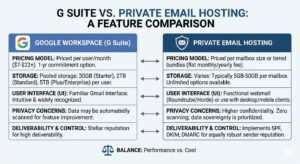
Pricing model
- Google Workspace: Priced per user, per month. There’s also an option of 1 year commitment. This starts at $7 per user for the Starter plan and increases to $22 for the Plus plan. If you want the Enterprise plan, you Contact sales for pricing.
- Private email hosting: Often priced per mailbox size, but many providers also offer tiered plans where you get a set number of mailbox sizes (e.g., 10, 20, 25) for a flat monthly or yearly fee.
Storage
- Google Workspace: Starter plan offers 30GB of pooled storage per user, which includes Gmail, Drive, and Photos. Standard tier offers 2TB, while Plus and Enterprise tiers offer 5TB.
- Private email hosting: Varies widely by provider, typically offering between 5GB and 50GB per mailbox, sometimes with options for unlimited storage on higher and more expensive plans.
User Interface (UI)
- Google Workspace: Uses the familiar Gmail interface, which is intuitive and widely recognized.
- Private email hosting: Most providers offer a webmail interface (e.g., Roundcube, Horde, or custom solutions) that is accessible from any browser. These interfaces are functional and user-friendly, though they might lack some of the advanced features or “polish” of Gmail. All private emails can also be configured with desktop clients (Outlook, Thunderbird) and mobile apps.
Privacy concerns
This is a critical distinction.
- Google Workspace: Google’s business model often involves scanning data (albeit automated and for feature improvement or smart replies) within their ecosystem. For businesses in highly regulated industries (legal, healthcare, finance) or those dealing with sensitive client information, this can be a deal-breaker.
- Private email hosting: Private email hosting providers, particularly those with strong privacy policies, explicitly state that they do not scan your email content and that your data remains exclusively yours, offering a higher degree of confidentiality and data sovereignty.
Deliverability and technical control
Many believe Google Workspace offers superior email deliverability (less chance of ending up in spam). While Google’s reputation is indeed stellar, private email hosting providers implement the same critical email authentication protocols: SPF (Sender Policy Framework), DKIM (DomainKeys Identified Mail), and DMARC (Domain-based Message Authentication, Reporting & Conformance).
When configured correctly, these protocols give your private email the same robust sender reputation as Google, to ensure your important communications reliably reach the inbox.
When to choose Google Workspace
Google Workspace is the ideal choice if:
- Your team heavily relies on real-time collaboration on documents (Docs, Sheets, Slides).
- Video conferencing (Google Meet) is a daily necessity for internal and external meetings.
- Your business is already deeply integrated into the Google ecosystem and wants to leverage all its services from one dashboard.
- The per-user cost aligns perfectly with your budget, even as you scale.
When to choose private email hosting
Private email hosting is the superior option if:
- You need a professional, domain-based email primarily, without the need for an extensive productivity suite.
- Cost-effectiveness and predictable pricing are critical, especially for a growing team where per-user costs quickly add up.
- Data privacy and ownership are paramount for your industry or client base.
- You prefer using alternative tools for document collaboration (e.g., Microsoft Office, Slack) and don’t need Google’s integrated suite.
- You want robust security (spam, malware) and high deliverability for your emails.
Final Words
There is no single better answer between Google Workspace and private email hosting. The right choice hinges entirely on your business’s unique operational needs, budget constraints, and philosophical approach to data.
If seamless integration across a full suite of productivity tools is your priority and your budget allows, Google Workspace shines. However, if your core need is secure, private, and cost-effective professional email with a focus on core communication, private hosting offers a compelling, often more financially sensible, alternative.
Ready to find the perfect balance of performance and price for your business communication? Get started with reliable email hosting from Tiwahost today and choose the solution that truly empowers your growth.